
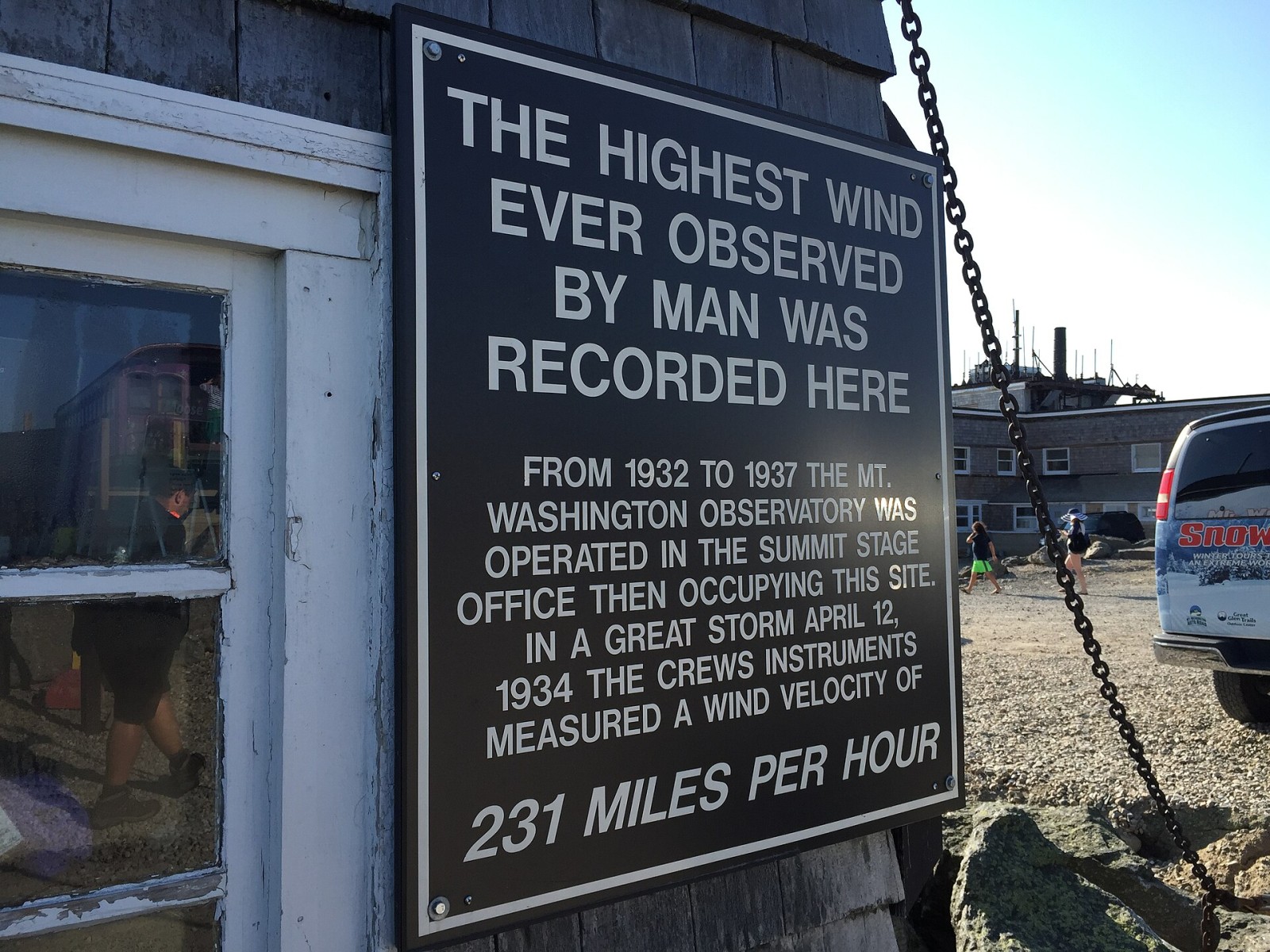
Photo of Mount Washington Observatory site of the world wind speed record.
April 12, 1934. The summit of Mount Washington, New Hampshire. Three observers huddled inside the small stone building at the top of the Northeast’s highest peak as conditions outside deteriorated into something beyond an ordinary storm.
At 1:21 p.m., their anemometer recorded a wind gust of 231 miles per hour. For the next 62 years, it would stand as the highest surface wind speed ever recorded on Earth.
231 mph
World Record Surface Wind Speed
Mount Washington, New Hampshire · April 12, 1934 · 1:21 p.m.
The Day of the Record
Three observers. One measurement. A record that lasted 62 years.
The observers on duty that day — Salvatore Pagliuca, Alexander McKenzie, and Wendell Stephenson — knew something extraordinary was building. A powerful extratropical cyclone had deepened rapidly over the region, funneling winds up the mountain’s exposed western slopes and over its summit. The observatory’s instruments had been tested and calibrated. When the gust hit, the reading was unmistakable.
The record held until 1996, when a tropical cyclone in Australia produced a measured gust of 253 mph. But for surface observatories of the kind that Blue Hill and Mount Washington represent, the 1934 record remains a benchmark for what our atmosphere is capable of.
A Shared Legacy
Two observatories. One tradition.
Blue Hill Observatory and Mount Washington Observatory share more than geography. Both were established in the late 19th century to advance mountain meteorology in the northeastern United States. Both have maintained continuous observational records that form the backbone of regional climate science. And both were shaped by a generation of meteorologists who believed that the only way to understand the atmosphere was to live inside it.
Abbott Lawrence Rotch, who founded Blue Hill in 1885, corresponded regularly with the scientific community that would eventually establish Mount Washington’s permanent year-round station. The two observatories represent twin pillars of the American tradition of high-elevation weather observation — a tradition that continues today.
This April, as you watch the wind move through the trees on Great Blue Hill, consider what 231 mph might feel like — and be grateful for the observers, past and present, who stood in it so science could learn something.


