
In the News
Our Blueberry Bush Makes National Headlines
A century-old blueberry bush on our summit is helping tell the story of a warming climate — and NPR and WBUR both came to Blue Hill to find out how.
For 141 years, Blue Hill Observatory has tracked the date our wild blueberry bush produces its first ripe berry each summer — a simple, low-tech measurement that turns out to be a powerful climate indicator. This month, that story reached a national audience, with feature coverage from both WBUR and NPR’s Morning Edition.
WBUR — July 6, 2026
What One Mass. Blueberry Bush Tells Scientists About Climate Change
Reporter Bianca Garcia spent time on the summit with Deputy Chief Observer Amanda Joly and Chief Scientist Mike Iacono, tracing how 141 unbroken years of the same taste-test observation reveal that the bush now ripens, on average, about a week earlier than it did at the turn of the 20th century. Phenology researcher Theresa Crimmins, who called the dataset “phenomenal… really rare,” notes the pattern lines up with seasonal shifts scientists are seeing worldwide.
Read the full WBUR feature →NPR Morning Edition — July 8, 2026
In Massachusetts, the Season’s First Blueberries Help Scientist Track Climate Change
NPR’s national broadcast picked up the same story, following Amanda Joly’s day-by-day watch on the bush through June — and Chief Observer Matthew Douglas’s claim to fame as the one who actually tasted this year’s first ripe berry on June 24 (“not too sweet, not too tart,” by his account). The piece situates Blue Hill’s record alongside broader research on how warming winters are shifting seasonal timing across the region.
Listen to or read the NPR segment →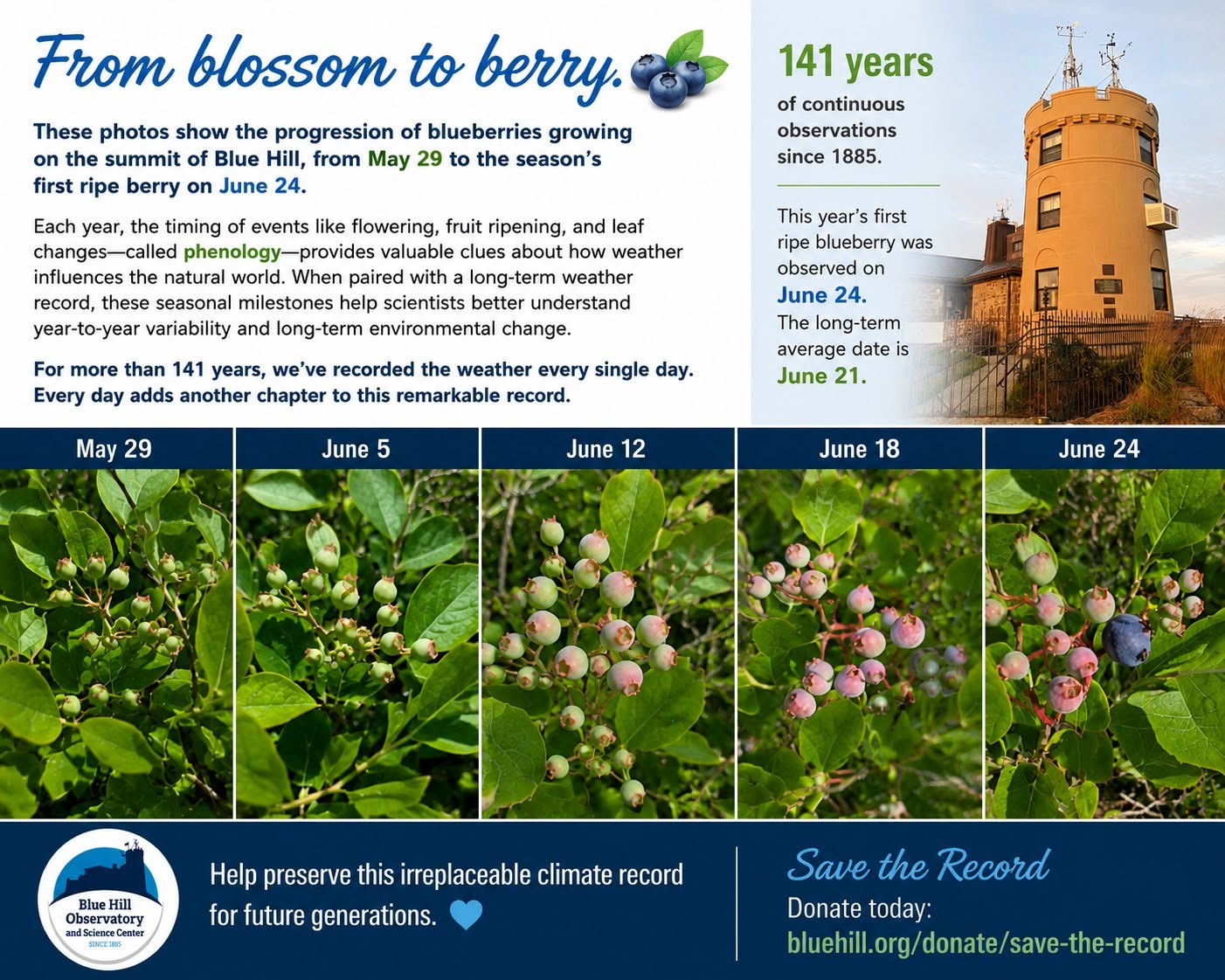
These photos capture the progression of wild blueberries growing on the summit of Blue Hill, from May 29 to the season’s first ripe berry on June 24.
The timing of seasonal events like flowering, fruit ripening, and autumn leaf color — known as phenology — helps scientists understand how weather influences the natural world. When paired with one of the world’s longest continuous weather records, these observations become even more valuable.
This year’s first ripe blueberry was observed on June 24, just a few days later than the long-term average of June 21. Every year’s observation becomes another piece of a record that has been carefully maintained since 1885.
These are the kinds of observations that help researchers understand how seasons vary from year to year and how our environment changes over decades.


