
Sign In Become a Member
Weather Summary Archives

2015 Was Warmer, Drier and Sunnier Than Average

January 5, 2016

The year 2015 ended with a 24-hour corrected mean temperature of 49.6F, which was 2.0F warmer than the 120-year mean and 0.7F…

Agreement required — click “Accept & Continue” below to review and accept the Data Use & Privacy Policy

Access to this content requires acceptance of our Data Use & Privacy Policy.
BHO_2015Summary

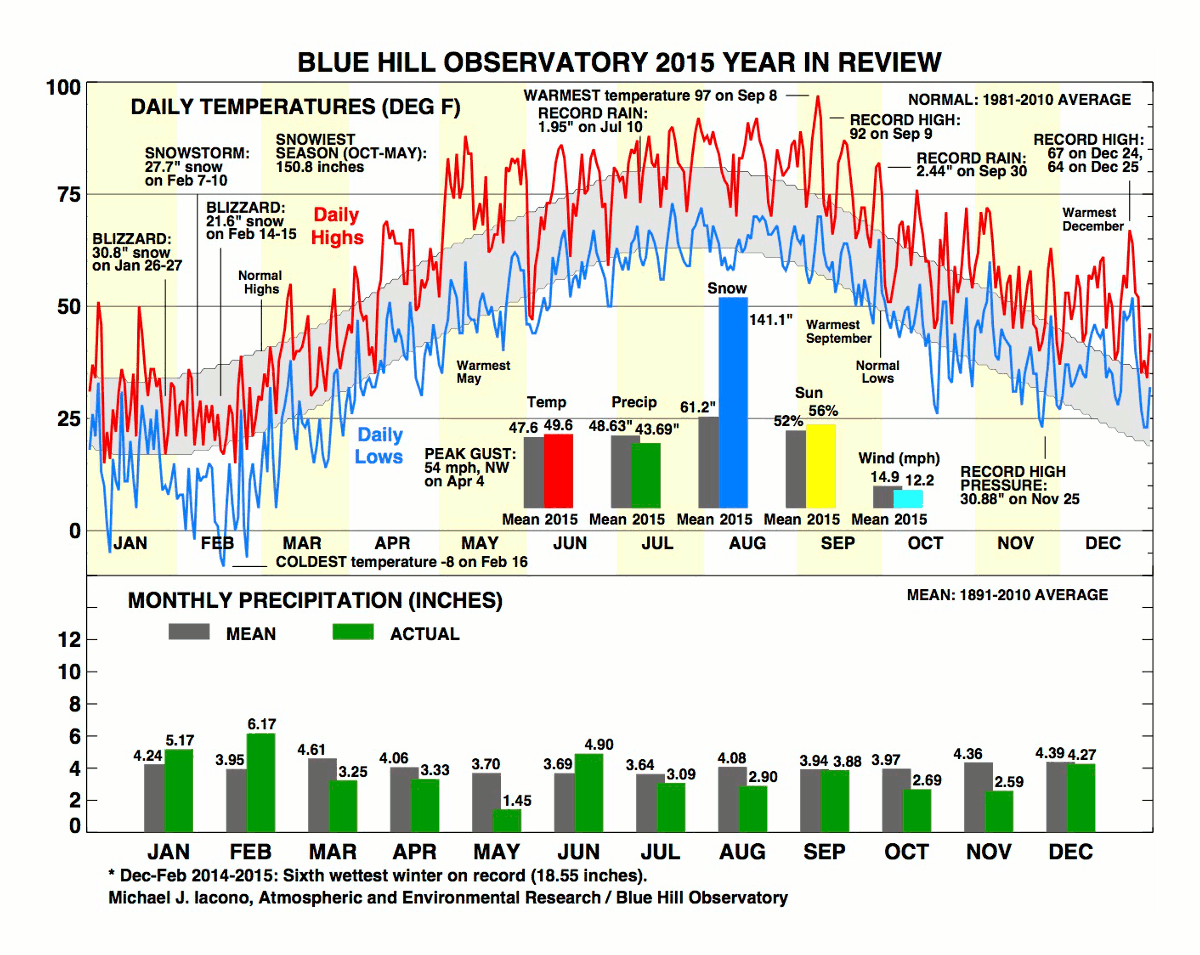
The year 2015 ended with a 24-hour corrected mean temperature of 49.6F, which was 2.0F warmer than the 120-year mean and 0.7F above the 30-year normal. This was the fifteenth warmest year on record and the warmest since the record year of 2012. The year got off to a frigid start with a cold January and March and the third coldest February on record, but the next nine months were all near or warmer than the long-term average. The first three months of the year combined were the ninth coldest on record for that period and the coldest since 1934. The coldest temperature during 2015 was -8F on February 16th, and a total of five days in January and February had minimum temperatures below zero.  Later in the year, three months established new records for the warmest month, including May, September and December. The maximum temperature for the year was 97F on September 8th, which was the second warmest temperature ever measured in September and the warmest so late in the season. Three consecutive days in the 90s on September 7th-9th provided only the second heat wave ever observed in September (the other occurring in 1895). There were eight 90-degree days in 2015, two more than the long-term average, and three of these occurred in September. The last month of the year was consistently warmer than average with seven days that were twenty degrees or more warmer than normal with four such days in a row from December 22nd-25th. The maximum temperatures on December 24th (67F) and December 25th (64F) both set new daily records.

A residual effect of the cold weather in February and March was the very late thaws of two local ponds this year. Houghton’s Pond was considered free of ice on April 10th, which tied for the second latest thaw date ever observed, and Ponkapoag Pond was considered thawed on April 11th, which was the latest thaw date on record for that pond in the last 130 years. Yet only two months later, the first ripe blueberries were observed on the summit on June 12th, which was about nine days earlier than the long-term mean date.

Annual precipitation totaled 43.69 inches, which was about five inches drier than the 120-year average and about ten inches less than the 1981-2010 30-year average. This was the driest year since 2012. Only three months during 2015 exceeded the long-term average precipitation: January, February and June. The remaining months were all drier than average, with May being the driest month with only 1.45 inches. February brought the most liquid equivalent precipitation of any month with 6.17 inches. There were 16 days with thunderstorms during the year, which was six fewer than average. Several extreme rainfall events occurred during the year. Downpours associated with strong thunderstorms brought 2.03 inches in a few hours on July 9th-10th, which included a new daily record of 1.95 inches on July 10th.  Tropical rains along a cold front brought a total of 2.53 inches on September 29th-30th, and this included a new daily record of 2.44 inches on September 30th. A precipitation total of 1.58 inches fell in less than 24 hours on October 28th-29th in heavy rainfall that was in part associated with the remnants of Hurricane Patricia.

Snowfall for the calendar year was excessive with a total of 141.1 inches, or about 80 inches more than the long-term average of 61 inches, and this surpassed the previous record of 125.2 inches in 1996. Most of this snowfall, 126.5 inches, fell in the snowy months of January and February 2015. The January total of 42.9 inches made this the eighth snowiest January on record, and the February total of 83.6 inches was a new record for any month of the year surpassing 65.4 inches in February 1969. Much of this snow fell in about three weeks from late January to mid-February due to a series of several historic snowfalls and blizzards including 30.8 inches on January 26th-27th (the second greatest snowstorm on record), 16.5 inches on February 2nd, 27.7 inches on February 7th-10th (the 7th largest snowfall on record), and 21.6 inches on February 14th-15th.  The snow depth on the summit of Great Blue Hill reached a maximum of 46 inches on February 15th, which was also a new record for the Observatory. The final seasonal snowfall for 2014-2015 was 150.8 inches, which surpassed the previous seasonal record of 144.4 inches in 1995-1996.

The mean station pressure on the summit of Great Blue Hill during 2015 was 29.34 inches, which tied with 1906, 1911, 1946, and 1949 for the highest mean station pressure for any year on record since 1885. This is 0.05 inches higher than the long-term annual mean of 29.29 inches. The highest sea-level pressure during the year was 30.88 inches on November 25th, which tied for the highest sea-level pressure ever measured in that month with a similar reading in November 1932. The lowest sea-level pressure during 2015 was 29.16 inches on January 24th, which occurred during the moderate snowfall on that date that started the intense period of cold and snow that lasted into February.

The annual mean wind speed of 12.2 mph tied for the second lowest on record with 2013, behind only the 11.8 mph mean observed in 2012. This continues the several decade long trend of decreasing mean wind speeds on Blue Hill. The peak wind gust for the year was only 54 mph from the NW during a thunderstorm on April 4th. This was the lowest peak gust for an entire year in the last 50 years.

Bright sunshine for the year was very high at 56 percent of possible, which was four percent more than the long-term average, and this was the most bright sunshine for any year since 2007.

BHO Greatest Annual Snowfall, inches (1885-2015):

1) 141.1 in 2015
2) 125.2 in 1996
3) 124.4 in 1967
4) 122.4 in 1956
5) 116.3 in 1945
6) 112.0 in 2003
7) 111.9 in 2005
8) 110.2 in 1916
9) 108.1 in 1904
10) 104.4 in 1948

BHO Lowest Annual Mean Wind Speed, mph (1885-2015):

1) 11.8 in 2012
2) 12.2 in 2013
   12.2 in 2015
4) 12.3 in 2014
5) 12.5 in 2011
6) 12.6 in 2008
   12.6 in 2009

BHO Lowest Annual Peak Wind Gust, mph (1965-2015):

1) 54 W in 2015
2) 62 S in 2014
3) 64 W in 2001
4) 67 ENE in 2010
5) 68 S in 2005

BHO Highest Annual Mean Vapor Pressure, mb (1885-2015):

1) 11.0 in 2012
2) 10.9 in 2011
3) 10.7 in 1973
4) 10.6 in 1979
   10.6 in 2006
6) 10.5 n 1949
   10.5 in 2013
   10.5 in 2015


Please follow and like us:
Blue Hill Observatory & Science Center · Legal

Data Use & Privacy Policy

Please read the full Policy before accessing Observatory data · Effective January 1, 2025

Notice: By accessing, downloading, or using any Blue Hill Observatory data or services, you unconditionally accept and agree to be bound by this Policy in its entirety. If you do not agree, you may not access or use Observatory data.
Effective January 1, 2025 · Milton, Massachusetts · bluehill.org
Part I — Data Use Policy
§ 01

Ownership and Proprietary Rights

All observational records, compiled datasets, metadata, database structures, and related materials provided by the Blue Hill Observatory & Science Center are the exclusive property of the Blue Hill Observatory & Science Center. The Observatory has maintained continuous weather observations at the summit of Great Blue Hill since 1885, and the entirety of that record — its compilation, structure, curation, and organization — constitutes a proprietary database protected under applicable United States law, including copyright law and common law database protections.

All rights not expressly granted in this Policy are reserved by the Observatory. No access to or use of Observatory data shall be construed as a waiver of any rights or as a license to use data beyond the scope expressly stated herein.

§ 02

Governing Law and Jurisdiction

This Policy shall be governed by and construed in accordance with the laws of the Commonwealth of Massachusetts, without regard to its conflict of law provisions. For interactions with international users, this Policy shall apply to the maximum extent permitted by applicable local law.

Any dispute arising from or related to this Policy shall be subject to the exclusive jurisdiction of the state and federal courts located in Norfolk County, Massachusetts. By accessing Observatory data, all users consent to personal jurisdiction in Massachusetts and waive any objection to the venue or inconvenience of such forum.

§ 03

Permitted Uses

Observatory data are made available for the following limited, non-commercial purposes only:

  • Personal study and analysis
  • Educational classroom use
  • Student projects
  • Non-commercial academic research
  • Publication of analyses, figures, models, or conclusions derived from the data, subject to the attribution requirements of Section 4

All other uses require prior written authorization from the Observatory.

§ 04

Attribution Requirement

Any use of Observatory data in any published, presented, or publicly distributed work must include the following verbatim acknowledgment:

“Data provided by the Blue Hill Observatory & Science Center, Milton, Massachusetts. Continuous weather observations since 1885.”

Failure to include proper attribution is a material violation of this Policy.

§ 05

Prohibited Uses

Unless explicitly authorized in writing, Users may not:

  • Resell, license, sublicense, or commercially exploit Observatory data in any form
  • Redistribute the dataset in whole or in part to any third party
  • Publish the dataset for download by third parties
  • Host, mirror, or archive the dataset on any external website, repository, or storage service
  • Upload the dataset to any public or institutional data repository
  • Provide the data through APIs, automated services, or subscription platforms
  • Incorporate the data into any commercial product, software, application, or service
  • Use the data for AI or machine learning systems intended for commercial use or external distribution
  • Use the data to create derivative datasets that enable reconstruction of the underlying observations
§ 06

Commercial Licensing

Organizations seeking to use Observatory data for commercial purposes must obtain a license prior to any such use. Licensing inquiries: data@bluehill.org.

§ 07

Automated Access

Automated scraping, bulk harvesting, or systematic downloading of Observatory data is strictly prohibited without prior written authorization.

§ 08

Enforcement and Remedies

Violation of this Policy may result in immediate revocation of data access, pursuit of legal remedies available under United States law, and referral to applicable authorities. The Observatory reserves all rights to seek injunctive relief, damages, and attorneys’ fees in connection with any unauthorized use of its data.

Part II — Privacy Policy
§ 09–10

Scope & Information Collected

This section governs the collection, use, storage, and disclosure of personal information from visitors to the Blue Hill Observatory website and users of its data services. The Observatory may collect contact information (name, email, organization) when voluntarily submitted, usage data including IP addresses and pages visited, and data download records.

§ 11–12

How We Use Information & Retention

Information is used solely for: responding to inquiries and licensing requests; monitoring and enforcing compliance with this Policy; improving website performance; and communicating Observatory news to opted-in users. The Observatory does not sell, rent, or share personal information with third parties for marketing purposes. Data access records may be retained indefinitely for compliance and enforcement purposes.

§ 13

International Users and Data Transfers

The Observatory is located in the United States. International users acknowledge their information will be processed in the United States under U.S. law. Users requiring specific data processing agreements under non-US law must contact data@bluehill.org before accessing data.

§ 14–16

Cookies, Security & Children’s Privacy

The Observatory website may use cookies for analytics and functionality. By continuing to use the site, users consent to cookie use. The Observatory implements reasonable measures to protect personal information but cannot guarantee absolute security. Observatory data services are not directed at children under 13.

Part III — General Provisions
§ 17–20

Modifications, Severability, Entire Agreement & Contact

The Observatory reserves the right to modify this Policy at any time. Updated versions will be posted at bluehill.org. Continued use of Observatory data following any modification constitutes acceptance of the revised Policy. This Policy constitutes the entire agreement between the User and the Observatory. Questions and licensing inquiries: Blue Hill Observatory & Science Center, Milton, Massachusetts — data@bluehill.org

By accessing, downloading, or using any Blue Hill Observatory data or services, you acknowledge that you have read, understood, and agree to be bound by this Policy.
Effective January 1, 2025 · Blue Hill Observatory & Science Center · Milton, Massachusetts