
Access to this content requires acceptance of our Data Use & Privacy Policy.
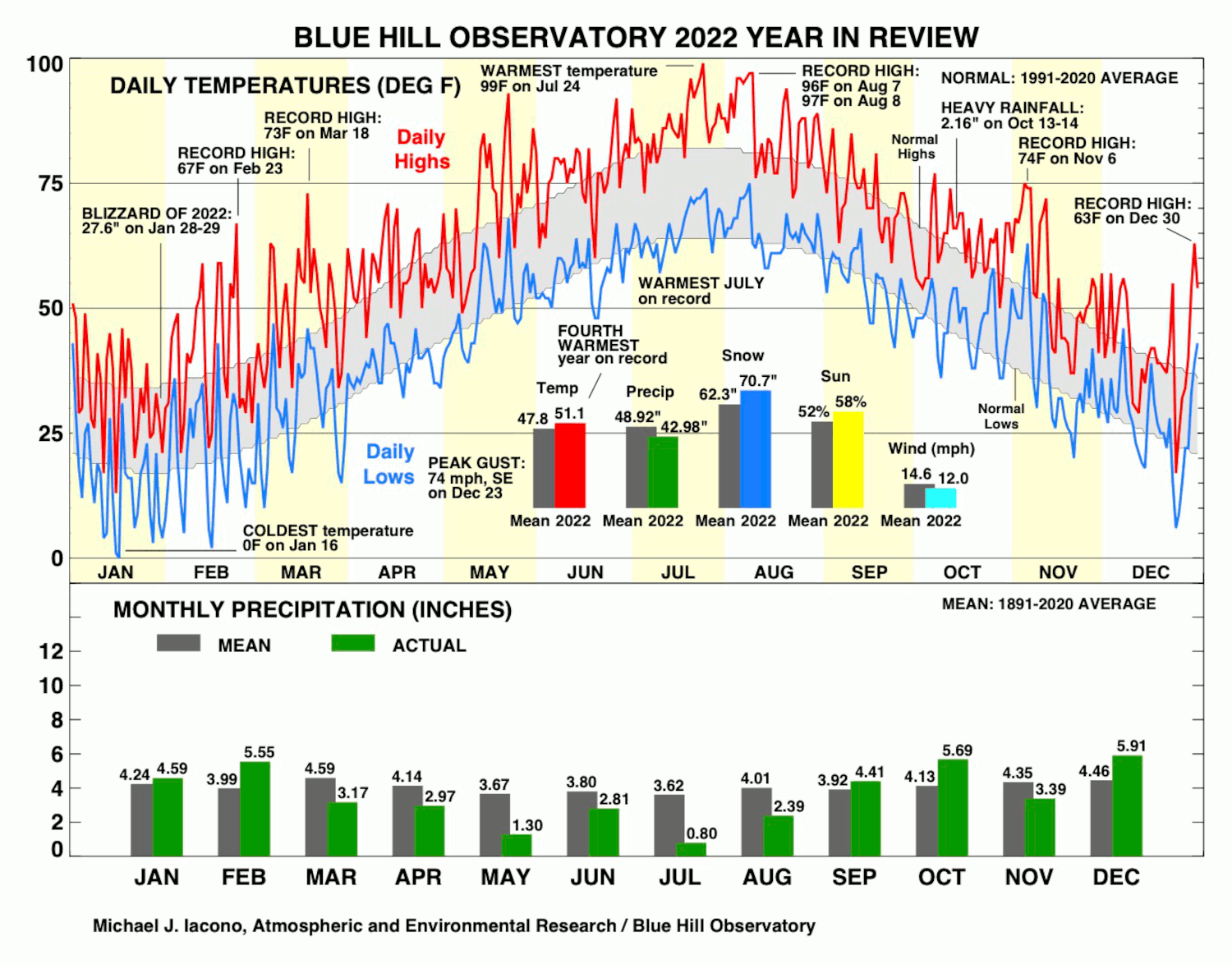
The year 2022 was exceptionally warm and ranked as the fourth warmest on record. The approximated 24-hour mean temperature of 51.1F was 3.3F warmer than the 130-year (1891-2020) long-term mean and 1.6F above the 30-year (1991-2020) average. Every month was warmer than the long-term mean except for January. The annual average maximum temperature of 60.9F, which was the warmest on record for any year, was 2.6F warmer than the 30-year normal. The annual average minimum temperature of 42.4F was 1.3F warmer than the 30-year normal, and it tied as the tenth warmest on record. Each of the last three years was among the six warmest years on record, and the nine warmest years since 1885 have all occurred since 1998.
The year started with generally cold and snowy weather in January with two significant snowstorms in that month. Eleven days in January had low temperatures in the single digits, and the lowest temperature of the year was 0F on January 16th. February temperature was more variable with frequent swings between cold and warm from a monthly low of 2F on February 15th to a monthly high and daily record high of 67F on February 23rd, which also tied as the sixth warmest temperature ever measured in February. The warmth continued into the spring months peaking with a daily record tying 93F on May 22nd, the first 90-degree temperature of the year, and March-May was the 5th warmest spring on record. After a slightly warm June, July was the warmest on record with the heat in July peaking in a six-day long heat wave on the July 19th to 24th, which included the warmest temperature of the year and a daily record of 99F on July 24th. A second six-day heat wave occurred on August 4th to 9th with high readings of 97F on the 8th and 9th. These heat waves were among the ten longest ever recorded since 1885, and it was the first time in history at Blue Hill that two heat wave of six days or longer occurred in a single year. Both August and Summer 2022 were the second warmest ever observed, and this exaggerated an extensive period of severe to extreme drought over much of eastern New England this summer. There were 19 90-degree days during 2022, which was 12 more than average, and this number was the most since 20 were observed in 2010. September temperature was closer to average, but warmth returned in October through November, and Fall 2022 was the sixth warmest on record. The last days of October and the first 12 days of November were exceptionally warm including four straight days in the 70s on November 4th to 7th. Both the high temperature of 74F and the low temperature of 63F on the 6th were records for the date, and in terms of the mean temperature of 69F (and the four cooling degree days for the day), the 6th was the warmest day ever observed in November at Blue Hill. December temperatures were more variable from a daily high of 55F on December 23rd to the monthly low of 6F on the 24th, following the passage of a strong Arctic cold front the day before, to the monthly high and daily record of 63F on December 30th to finish the year on a warm note.
Due to the cold weather early in the year, Ponkapoag Pond was not considered free of ice until March 6th, ten days earlier than the long-term mean date, and Houghton’s Pond thawed on March 11th, nine days earlier than the mean date. The first ripe blueberries were observed on the summit of Great Blue Hill on June 27th, which was six days later than the average date. Late in the year, Ponkapoag Pond froze over on December 25th, and Houghton’s Pond froze over on December 27th.
The year started with more precipitation than average in January and February, which was followed by six months of dry weather during spring and summer that produced wide areas of severe drought across eastern Massachusetts before the drought eased in the final months of the year. The annual total precipitation of 42.98 inches was 10.88 inches less than the 1991-2020 30-year normal. No month during 2022 had more than six inches of precipitation; the wettest month was December with 5.91 inches and the driest month was July with only 0.80 inches, making July the fourth driest on record. Summer 2022 had only 6.00 inches of rainfall, which was a little more than half of the normal precipitation for June-August, and summer was the eighth driest on record. There were several significant storms during the year, though there were no direct impacts from tropical cyclones. The wettest precipitation events of the year included 1.84 inches during the largest snowstorm of the year on January 28th-29th. Another winter storm on February 3rd-5th, which brought 1.70 inches of liquid equivalent precipitation, began as rain before turning into a long period of sleet and ending as a small amount of snow. After six months of only modest rainfall events through spring and summer, the drought started to ease with a rain storm that brought 2.40 inches on September 5th-6th. October had two significant rainfall events that brought 1.76 inches on 4th-6th and 2.17 inches on the 13th-14th. In December, one rain event brought a storm total of 2.42 inches on the 15th-17th, which ended as a small amount of snow, while another brought a storm total of 1.65 inches on the 22nd-23rd, which was ended by an Arctic front that brought a rapid drop in temperature. Both of the December storms were major winter events across the country with significant snow in the northern states and around the Great Lakes and severe weather to the south. There were 18 thunderstorm days during 2022 at Blue Hill, which was four fewer than average.
Following a modest snowstorm of 15.7 inches on January 7th, the largest snowstorm of the year was the historic Blizzard of 2022, which brought 27.6 inches on January 28th-29th. This storm brought many hours of heavy snow, strong winds, and blizzard conditions to Blue Hill, including a peak wind gust to 55 mph from the north. This was the second greatest snowstorm ever observed in January at Blue Hill. The calendar day snowfall of 27.1 inches on January 29th surpassed the previous record for the date of 8.0 inches in 1943, and it was the largest for any calendar day in January. The storm total of 27.6 inches was also the seventh greatest snowstorm ever measured at Blue Hill for any month of the year. The monthly snowfall for January of 45.4 inches made the month the sixth snowiest January on record. Snowfall was modest for the rest of the year with no other major events, and the snowfall for the calendar year of 70.7 inches was about ten percent more than average.
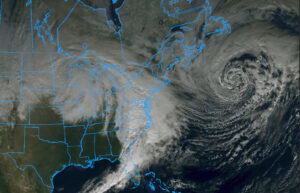
The mean station pressure during 2022 at the elevation of the mercury barometer at the Observatory was 29.32 inches, which was 0.03 inches (about 1 mb) higher than the long-term annual mean of 29.29 inches. The maximum sea-level pressure during the year was 30.76 inches on February 16th. The lowest sea-level pressure during 2022 was 29.04 inches on December 23rd during the passage of a large, intense inland storm that brought record snows to areas around the Great Lakes and swept frigid Arctic air across much of the eastern United States for several days.
Water vapor pressure, which is derived from the dew point and is an absolute measure of the amount of moisture in the air in terms of the pressure that water vapor contributes to the total surface pressure, averaged 10.7 mb (0.316 inches) during 2022. This value tied as the sixth highest on record and continued a trend of higher vapor pressures in recent decades, which is consistent with the increasing trend in temperature. Another way to interpret this value is to state that water vapor on average comprised a little over one percent of the total annual mean station pressure during the year.
The annual mean wind speed of 12.0 mph tied as the third lowest on record for any year. This average continued the several decades long trend of decreasing mean wind speeds on Blue Hill. Only one wind gust exceeded 70 mph during 2022, which was a gust to 74 mph from the southeast on December 23rd during the low pressures on that date as warm air rushed into Southern New England prior to the arrival of the Arctic front that evening. Another strong gust during the year was 66 mph from the south on February 22nd.
Bright sunshine for the year was 58 percent of possible, which was six percent more than the long-term average, and the year was the fifth sunniest on record. The least sunny month was February with 49 percent of the possible bright sunshine. The sunniest month of the year was July, which had 73 percent of the possible sunshine, and month was the third sunniest July on record.
BHO Warmest Annual Approximated 24-Hour Mean Temperature, deg F (1885-2022):
1) 51.7 in 2012
2) 51.3 in 2020
3) 51.2 in 2016
4) 51.1 in 2022
5) 51.0 in 2010
6) 50.9 in 1999
50.9 in 2021
8) 50.8 in 1998
9) 50.6 in 2006
10) 50.5 in 1953
BHO Warmest Annual Maximum Temperature, deg F (1885-2022):
1) 60.9 in 2022
2) 60.8 in 2012
3) 60.6 in 2016
4) 60.5 in 1949
5) 60.4 in 2020
6) 60.2 in 1999
7) 60.1 in 1953
60.1 in 2010
9) 59.9 in 1991
10) 59.7 in 1990
59.7 in 2021
BHO Warmest Annual Minimum Temperature, deg F (1885-2022):
1) 44.0 in 2012
2) 43.4 in 2020
3) 43.2 in 1998
4) 43.1 in 2006
43.1 in 2021
6) 43.0 in 2010
7) 42.8 in 2016
8) 42.7 in 1999
42.7 in 2011
10) 42.4 in 2017
42.4 in 2022
BHO Highest Annual Mean Water Vapor Pressure, mb (1932-2022):
1) 11.0 in 2012
11.0 in 2018
3) 10.9 in 2011
10.9 in 2021
5) 10.8 in 2020
6) 10.7 in 1973
10.7 in 2022
BHO Lowest Annual Mean Wind Speed, mph (1885-2022):
1) 11.5 in 2021
2) 11.8 in 2012
3) 12.0 in 2020
12.0 in 2022
5) 12.1 in 2018
12.1 in 2019
7) 12.2 in 2013
12.2 in 2015
12.2 in 2017
BHO Highest Annual Bright Sunshine, hours (1886-2022):
1) 2583.4 in 1965 (60%)
2) 2554.2 in 1963 (59%)
3) 2527.1 in 1966 (59%)
4) 2520.2 in 1964 (59%)
5) 2512.4 in 2022 (58%)
6) 2497.1 in 1978 (58%)
7) 2494.1 in 2001 (58%)
8) 2493.8 in 1976 (58%)
9) 2476.3 in 1899 (58%)
10) 2475.7 in 1908 (58%)
Mike Iacono
Chief Scientist
Blue Hill Observatory


